

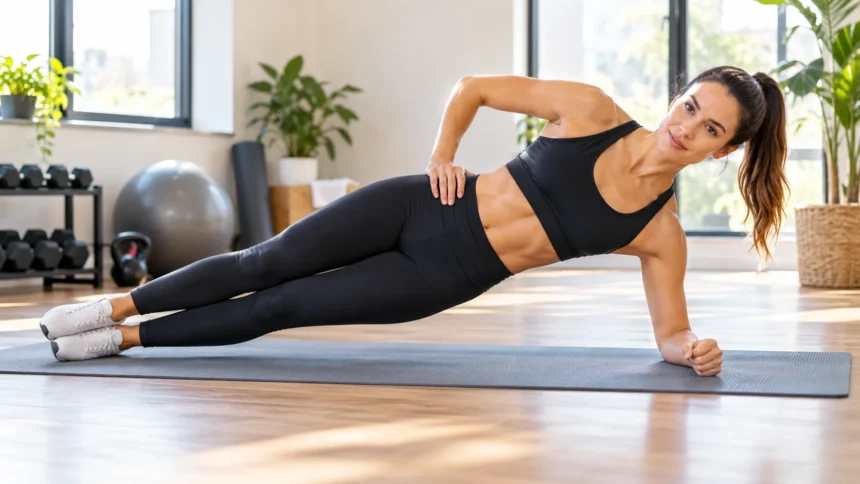
Side plank hip lifts are an effective core-strengthening exercise that targets the obliques, improves stability, and supports better body control. This exercise combines the benefits of a traditional side plank with controlled hip movements, making it useful for developing strength around the waist, hips, and shoulders. It requires minimal equipment and can be adapted for different fitness levels.
Many people focus on crunches and sit-ups when training their abdominal muscles, but these exercises do not challenge every aspect of core stability. Side plank hip lifts introduce controlled movement while the body works to maintain balance. This makes them a useful addition to home workouts, strength training sessions, and general fitness routines.
Learning proper technique is essential for getting the most from this movement. This guide explains side plank hip lift benefits, muscles worked, correct form, common mistakes, and practical ways to include the exercise in a balanced fitness program.
What Are Side Plank Hip Lifts?
Side plank hip lifts are a variation of the traditional side plank exercise that involves raising and lowering the hips while maintaining a stable body position. The movement primarily challenges the muscles along the sides of the abdomen. It also engages muscles around the hips and shoulders. Unlike a static side plank, this variation introduces controlled movement throughout each repetition.
The exercise is typically performed while supporting the upper body on one forearm and maintaining a sideways position. As the hips move, the core muscles work to maintain alignment and prevent unnecessary twisting. This combination of stability and movement makes the exercise useful for developing functional strength. It can also improve awareness of body positioning during exercise.
Side plank hip lifts are suitable for many fitness levels because the movement can be modified. Beginners may use a bent-knee variation, while experienced individuals can perform the exercise with straight legs. The exercise does not require gym machines or heavy weights. A comfortable exercise mat and enough floor space are generally sufficient.
Muscles Worked During Side Plank Hip Lifts
The primary muscles involved in side plank hip lifts are the internal and external obliques. These muscles are located along the sides of the abdomen and help control trunk movement. They also resist unwanted rotation and contribute to spinal stability. During the exercise, the obliques support the body while controlling the upward and downward movement of the hips.
The transverse abdominis and other abdominal muscles also contribute to maintaining a stable position. These deeper core muscles help manage tension around the trunk during movement. The quadratus lumborum, located in the lower back, assists with controlling the sideways position. Together, these muscles support balance and coordinated movement rather than working independently.
Several supporting muscles also contribute to the exercise. The gluteus medius and other hip muscles help stabilize the pelvis, while the shoulder muscles maintain upper-body support. The forearm and surrounding stabilizers assist with maintaining contact with the floor. This coordinated muscle engagement makes side plank hip lifts a useful exercise for overall core stability.
Benefits of Side Plank Hip Lifts
One of the main benefits of side plank hip lifts is improved core strength. The exercise challenges the abdominal muscles to support body weight while controlling movement. Repeated practice may improve muscular endurance and the ability to maintain stability during everyday activities. A stronger core can also support better movement quality during other exercises.
Another benefit is improved balance and body awareness. Because the exercise uses a narrow base of support, the body must coordinate several muscle groups to remain stable. The hips, shoulders, and abdominal muscles work together throughout each repetition. This coordination can be valuable for activities that require controlled changes in body position.
Side plank hip lifts may also support hip stability and muscular endurance. The muscles around the pelvis help maintain alignment while the hips move through a comfortable range. Regular practice can strengthen these supporting muscles as part of a balanced routine. However, the exercise should not be viewed as a guaranteed solution for back pain or other medical conditions.
How to Do Side Plank Hip Lifts Correctly
Begin by lying on your side on a comfortable exercise mat. Position your elbow directly beneath your shoulder and place your forearm on the floor for support. Extend your legs and stack your feet, or place one foot slightly ahead for better balance. Keep your head aligned with your spine and avoid pushing your shoulder toward your ear.
Engage your abdominal muscles and lift your hips until your body forms a relatively straight line from your shoulders to your feet. Slowly lower your hips toward the floor without allowing your body to collapse. Raise your hips again through a controlled movement while keeping your torso facing forward. The motion should remain comfortable and free from sudden jerking.
Continue for a manageable number of repetitions before changing sides. Breathe naturally throughout the movement instead of holding your breath. Focus on maintaining alignment rather than lifting your hips as high as possible. Beginners can start with a smaller range of motion and gradually increase the challenge as their strength and control improve.
Proper Side Plank Hip Lift Form
Correct alignment is essential for performing side plank hip lifts effectively. Your supporting elbow should remain beneath your shoulder to distribute pressure more comfortably. Keep your chest facing forward and avoid allowing your upper shoulder to rotate toward the floor. Maintaining a stable upper body helps direct the movement toward the intended core and hip muscles.
The hips should move through a smooth and controlled range rather than dropping quickly toward the ground. As you lower, maintain enough abdominal engagement to prevent your lower back from twisting. When lifting, raise your hips until your body returns to a stable side plank position. Avoid exaggerating the movement or forcing your spine into an uncomfortable position.
Breathing also plays an important role in maintaining proper exercise technique. Exhale gently during the lifting phase and inhale as you lower your hips. Keep your neck relaxed and your gaze directed comfortably forward. Coordinating breathing with movement can make it easier to maintain a steady rhythm and avoid unnecessary tension.
Common Side Plank Hip Lift Mistakes
One common mistake is allowing the supporting shoulder to collapse toward the ear. This position can create unnecessary tension around the neck and shoulder. Instead, maintain gentle pressure through your forearm and keep your shoulder stable. If the position feels uncomfortable, consider using a modified variation or seeking guidance on proper alignment.
Another mistake is lowering the hips too quickly. Rapid movement reduces muscular control and may make it harder to maintain a stable spine. Side plank hip lifts are more effective when performed with deliberate, controlled motion. Slowing down also makes it easier to notice changes in alignment and correct them before they become uncomfortable.
Some people also twist their torso or shift their weight excessively during the exercise. This may happen when the chosen variation is too challenging or when fatigue develops. Reducing the range of movement can help maintain better control. Prioritizing accurate technique over repetition count supports safer and more consistent training.
Side Plank Hip Lifts for Beginners
Beginners can start with a modified side plank hip lift performed with bent knees. This variation reduces the amount of body weight supported by the core and shoulder. It also provides a more stable position for learning the movement. Using an exercise mat can make the supporting elbow and knees more comfortable.
Start by lying on your side with your knees bent and your elbow positioned beneath your shoulder. Keep your knees together and raise your hips until your body forms a straight line from shoulders to knees. Lower your hips slowly within a comfortable range. This shorter lever position makes it easier to focus on breathing and controlled movement.
Once the modified version feels comfortable, gradually introduce more challenging variations. You might extend the legs, adjust your foot position, or increase the number of controlled repetitions. Avoid progressing simply because a certain amount of time has passed. Your ability to maintain stable alignment without discomfort should guide the next step.
Side Plank Hip Lifts for Core Strength
Core strength involves more than developing visible abdominal muscles. The core supports the spine, transfers force between the upper and lower body, and contributes to controlled movement. Side plank hip lifts challenge these functions by requiring the trunk to remain stable during repeated hip movement. This makes them useful for developing strength beyond traditional abdominal exercises.
The movement particularly challenges lateral core stability, which helps the body resist excessive sideways bending. This function is important during activities such as walking, carrying objects, and changing direction. Training the obliques and supporting muscles may improve the body’s ability to manage these demands. However, everyday performance also depends on overall strength and coordination.
For balanced core development, combine side plank hip lifts with other types of exercises. Front planks, bird dogs, dead bugs, and controlled rotational movements challenge different aspects of trunk stability. Using several movement patterns provides more complete training than relying on one exercise. Each movement should be adjusted to match individual ability and comfort.
Side Plank Hip Lifts vs. Regular Side Planks
Regular side planks and side plank hip lifts target many of the same core muscles. However, they challenge the body in slightly different ways. A traditional side plank involves maintaining a stable position without repeated hip movement. Side plank hip lifts add a dynamic component that requires the muscles to control movement while supporting body weight.
Static side planks are useful for developing muscular endurance and learning proper alignment. They allow beginners to concentrate on maintaining a steady body position. Side plank hip lifts introduce a greater movement challenge once that position becomes manageable. Neither exercise is automatically better because their usefulness depends on individual goals and current strength.
Combining both variations can provide a balanced approach to lateral core training. A workout might include static side plank holds followed by controlled hip lifts when appropriate. This combination challenges the muscles through different demands without requiring additional equipment. Maintaining correct form remains more important than making either exercise unnecessarily difficult.
Side Plank Hip Lifts for Hip Stability
Hip stability plays an important role in walking, climbing stairs, running, and many other everyday movements. Muscles around the pelvis help control leg positioning and maintain balance. Side plank hip lifts engage several of these muscles while the body remains supported in a sideways position. This can contribute to a broader hip-strengthening program.
The gluteus medius is one of the muscles involved in controlling pelvic position. During side plank hip lifts, it helps stabilize the hips alongside other supporting muscles. Developing strength and endurance in this area may improve movement control during certain activities. However, hip stability also depends on coordination, mobility, and strength in other muscle groups.
People interested in improving hip control can combine side plank hip lifts with bridges, step-ups, and other suitable exercises. These movements challenge the hips through different positions and movement patterns. A varied program is generally more useful than repeatedly training the same movement. Individuals with hip pain should seek professional guidance before selecting challenging exercises.
Side Plank Hip Lifts for Athletes
Athletes often benefit from exercises that improve trunk stability during movement. Side plank hip lifts challenge the body to maintain alignment while transferring effort through the hips and shoulders. These abilities contribute to many sports that involve running, turning, or changing direction. The exercise can therefore serve as one component of a general athletic conditioning routine.
Sports such as football, basketball, tennis, and running require coordinated movement between the upper and lower body. Strong trunk muscles help support this coordination during demanding activities. Side plank hip lifts train lateral core control without requiring specialized equipment. However, improved performance depends on many factors, including sport-specific training and overall physical preparation.
Athletes should introduce this exercise according to their training experience and recovery needs. It can be included in a warm-up, core-strengthening session, or general conditioning program. The difficulty should match the athlete’s current ability rather than being increased unnecessarily. Maintaining quality movement helps ensure the exercise complements other training activities.
Side Plank Hip Lift Variations
The bent-knee side plank hip lift is one of the most accessible variations. It reduces the distance between the supporting points and makes the exercise easier to control. This version is useful for beginners or anyone returning to core training after a break. It still challenges the obliques while allowing greater attention to alignment.
A straight-leg variation increases the challenge by placing more demand on the core and supporting shoulder. The legs remain extended while the hips move slowly through a controlled range. Adjusting the position of the feet can make balancing easier or more difficult. This variation is appropriate when the modified exercise can be performed comfortably.
Another option is combining a static side plank hold with a few controlled hip lifts. The static portion emphasizes endurance, while the moving portion challenges coordination. People with sufficient strength may find this combination useful for variety. Advanced variations should only be introduced when basic technique remains consistent and comfortable.
How Many Side Plank Hip Lifts Should You Do?
The appropriate number of side plank hip lifts depends on your fitness level, exercise experience, and training goals. Beginners may find that five to eight controlled repetitions per side provide a reasonable starting point. More experienced individuals might perform eight to twelve repetitions when technique remains stable. These numbers are examples rather than requirements for every person.
One or two sets may be enough when introducing the movement into a workout. As muscular endurance improves, additional repetitions or sets can be considered gradually. Allowing adequate recovery between challenging sessions helps the muscles adapt. Exercise quality should determine the amount of training rather than an arbitrary target.
Stop a set when maintaining proper alignment becomes difficult or the movement causes pain. Fatigue is normal during strengthening exercises, but sharp discomfort is not something to push through. Beginners may benefit from practicing the movement two or three nonconsecutive days each week. Individual recovery needs and other training activities should guide frequency.
How to Add Side Plank Hip Lifts to Your Workout
Side plank hip lifts can fit into many workout routines because they require little space and no specialized equipment. They can be performed during a dedicated core session or included after general strength exercises. Some people prefer placing them near the beginning of a workout while their muscles are less fatigued. The ideal placement depends on the session’s main goals.
A balanced core routine might include dead bugs, bird dogs, regular planks, and side plank hip lifts. Each exercise challenges stability in a different way. Combining these movements helps build strength without relying exclusively on repeated abdominal bending. Keep the total workload manageable and focus on performing each exercise with proper control.
Consistency matters more than making every workout extremely challenging. Practicing suitable exercises regularly allows strength and coordination to develop gradually. Rest days, sufficient sleep, and balanced nutrition also support normal training recovery. Adjusting the exercise according to personal ability helps maintain a sustainable fitness routine over time.
Safety Tips and Best Practices
Before performing side plank hip lifts, prepare your body with gentle movement and a suitable warm-up. Light walking, comfortable trunk movements, and basic shoulder mobility exercises may help you feel ready. Use a stable, nonslip surface that provides enough cushioning for your supporting elbow. Avoid exercising on surfaces that make balancing difficult.
Pay attention to discomfort in the shoulder, neck, wrist, hip, or lower back. Mild muscular effort is expected, but sharp pain, numbness, or worsening symptoms are reasons to stop. Modifying the movement may reduce unnecessary strain. People recovering from injuries or managing persistent pain should consult a qualified healthcare professional before attempting demanding variations.
The best approach is to progress gradually while maintaining controlled technique. Begin with a variation that allows comfortable breathing and stable alignment. Increase the challenge only when the movement feels manageable and consistent. Side plank hip lifts should support your overall fitness rather than become a source of unnecessary strain.
Conclusion
Side plank hip lifts are a practical exercise for developing core strength, improving lateral stability, and challenging the muscles around the hips and shoulders. Their combination of controlled movement and body-weight support makes them useful for different fitness goals. With suitable modifications, beginners and experienced exercisers can include them in a balanced routine.
Proper technique remains essential for achieving the benefits of side plank hip lifts. Maintaining shoulder alignment, controlling hip movement, and breathing naturally can help reduce unnecessary strain. Starting with manageable repetitions and progressing gradually supports consistent improvement. Exercises should always be adjusted when discomfort or fatigue affects form.
Ultimately, side plank hip lifts work best as part of a broader strengthening program. Combining them with other core, hip, and full-body exercises provides more complete physical training. Regular practice, adequate recovery, and attention to movement quality can help improve strength and coordination. The goal is steady progress and comfortable movement rather than completing the highest number of repetitions.
Frequently Asked Questions (FAQs)
What muscles do side plank hip lifts work?
Side plank hip lifts primarily target the internal and external obliques. They also engage the transverse abdominis, quadratus lumborum, gluteal muscles, and shoulder stabilizers to support controlled movement and balance.
Are side plank hip lifts good for beginners?
Yes, beginners can perform side plank hip lifts using a bent-knee variation. Starting with a smaller range of motion and fewer repetitions makes the exercise easier to control while developing strength.
How many side plank hip lifts should I do daily?
There is no requirement to perform them daily. Beginners can consider five to eight controlled repetitions per side for one or two sets, allowing recovery between challenging sessions.
Do side plank hip lifts help strengthen the core?
Yes, side plank hip lifts challenge the obliques and other core muscles while maintaining body alignment. Regular practice can improve muscular strength, endurance, and lateral stability as part of a balanced exercise program.
What is the difference between side planks and side plank hip lifts?
A regular side plank involves holding a stable sideways position. Side plank hip lifts add controlled raising and lowering of the hips, creating a dynamic challenge for core and hip muscles.