

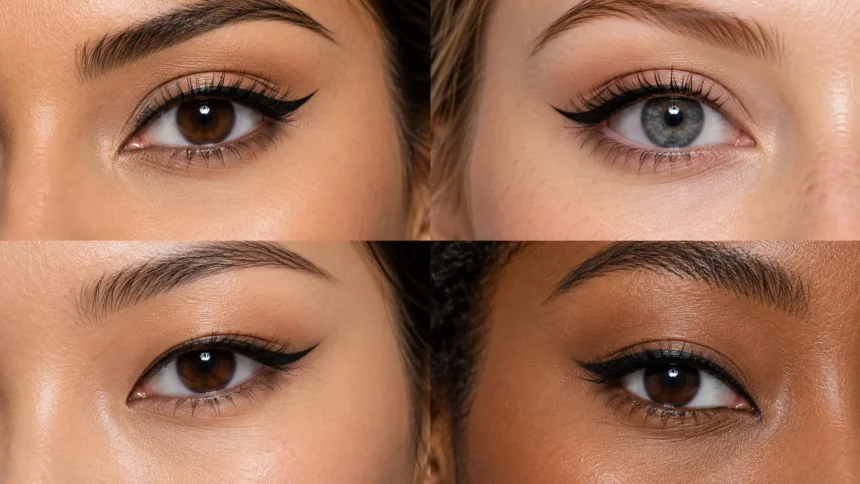
Best Eyeliner Styles for Different Eye Shapes
The best eyeliner styles for different eye shapes work with your natural features and the look you want to create. A thin lash line, soft outer flick, or bold wing can each change the effect of your makeup. Understanding your eyelids helps you place the liner where it remains visible and feels comfortable to apply.
Eye-shape categories are useful starting points, but most people fit more than one description. You might have almond-shaped eyes with hooded lids, or round eyes that sit slightly downward at the outer corners. Instead of searching for one perfect label, notice your visible lid space, outer-corner direction, and how your eyelid folds when open.
Eyeliner can emphasize length, roundness, or definition, but no natural eye shape needs correcting. The suggestions below give you options for exploring different effects rather than rules about how your eyes should look. Start with a small amount of product, check the result while looking forward, and adjust the style to your personal preferences.
How to Identify Your Eye Shape Before Choosing Eyeliner
Look straight into a mirror with your face relaxed and your eyes open normally. Notice whether you can see a distinct eyelid crease and how much movable lid remains visible beneath it. Then compare the position of the inner and outer corners, without raising your eyebrows or tilting your head to change the appearance.
Almond eyes generally have a more elongated outline, while round eyes appear more circular and may show white beneath the iris when looking forward. Hooded eyes have a fold that covers part of the movable lid. Monolids have no clearly visible crease, although their structure and the amount of visible lid space can vary considerably.
Also observe whether your eyes appear deep within the brow area, prominent, close together, or widely spaced. These characteristics can influence placement even when the overall outline fits another category. You do not need exact measurements to experiment; the most useful information is how eyeliner looks on your own eyes once they are fully open.
Soft Wings and Balanced Definition for Almond Eyes
Almond eyes often suit a range of eyeliner styles because their elongated outline works well with both simple definition and extended wings. For an everyday look, draw a thin line close to the upper lashes. Let it become slightly fuller toward the outer section if you want more emphasis without covering much of the lid.
A classic wing can continue the natural direction of the outer lash line and emphasize the eye’s length. Start with a short extension and connect it gently to the upper line, checking the shape while looking forward. You can keep the wing narrow for subtle definition or build it gradually when you want a stronger finish.
Almond eyes can also carry softly smudged liner when you prefer less precise edges. Blend a small amount of pencil along the upper lashes and concentrate additional depth near the outer corner. If your almond eyes are also hooded or deep-set, adjust the width and wing placement according to your visible lid space rather than relying on shape alone.
Outer-Corner Emphasis and Elongated Liner for Round Eyes
Round eyes can look striking with liner that emphasizes their natural openness or creates a more elongated effect. If you want to add length, focus on the upper lash line and outer corner. Keep the inner section delicate and gradually extend the outer edge instead of making the entire outline equally thick and dark.
A small outward wing can create a horizontal emphasis, especially when its direction follows the eye rather than rising sharply. Draw the extension with your eyes open so you can judge how it relates to the overall shape. A very steep flick produces a different effect, so test a few short angles before committing to a longer wing.
You can also celebrate roundness with a softly curved upper line and gentle definition beneath the lashes. Avoid assuming that lower liner is always unsuitable; its effect depends on the amount, color, and surrounding makeup. For a lighter result, blend only a little product beneath the outer lower lashes and compare it with the upper-only version.
Thin Lines and Open-Eye Wings for Hooded Eyes
Hooded eyes benefit from eyeliner placement that accounts for the fold covering part of the movable lid. A thick line may disappear into that fold or take up most of the visible space when the eyes open. Begin with a thin line along the upper lashes and check how much definition remains visible in your normal expression.
For a wing, look straight ahead and sketch the outer shape without closing your eye or lifting your eyebrow. This lets you place the visible portion where the fold will not unexpectedly interrupt it. Depending on your eyelid structure, the outline may need a small change in direction as it crosses the crease before connecting to the lash line.
A finished wing may look angular when the eye is closed but smooth when it is open, which is a normal result of adapting to folds. You can also choose a short outer flick or smudged pencil if a structured wing feels difficult. Allow the formula to set and avoid oversized applications if your liner tends to transfer.
Gradual Definition and Visible Wings for Monolid Eyes
Monolid eyes can suit delicate lash-line definition, bold liner, and softly blended shapes, depending on the amount of visible lid space. Begin with a thin line and look forward to see whether it remains visible. Add thickness only where it contributes to the effect you want rather than automatically drawing a wide band across the lid.
An extended outer wing can emphasize length, particularly when you plan its visible shape with your eyes open. Keep the first version short so you can compare both sides before enlarging it. If your lid partly covers the line near the lashes, adjust the outer placement gradually instead of repeatedly thickening every section in an attempt to reveal it.
Soft pencil eyeliner offers another option for creating depth without needing a sharply outlined finish. Blend near the upper lashes and fade the product gently upward or outward according to your chosen shape. Monolids vary considerably, so techniques that look effective on someone else may need different widths, angles, or blending on your own eyelids.
Fine Lash Lines and Soft Definition for Deep-Set Eyes
Deep-set eyes sit farther back beneath the surrounding brow area, which can create natural shadows around the lids. A fine upper lash line can add definition while leaving room for the rest of your eye makeup. Brown, charcoal, or another softer shade may suit a subtle look, although black remains an option when you prefer stronger contrast.
If you want a wing, keep its placement visible beyond the outer corner and check it from a relaxed forward-facing position. Avoid drawing solely within a shadowed crease where the shape may become difficult to see. The most useful wing length depends on your lid structure, so build a modest extension before testing a bolder version.
Heavy liner around the entire eye can create a more enclosed effect, but that may be exactly what a dramatic look calls for. For a lighter finish, keep lower definition soft or limited to the outer section. Consider the balance of liner, eyeshadow, and mascara together rather than expecting eyeliner alone to determine the final appearance.
Controlled Thickness and Defined Edges for Prominent Eyes
Prominent eyes project more noticeably within the eye area and can provide a clearly visible surface for eyeliner. A defined upper line can emphasize their contour, while a slightly fuller application creates a stronger frame. Start close to the lashes and increase the width gradually so you can see how much definition suits your intended look.
A wing that extends outward can introduce a sense of length, particularly when paired with a balanced upper line. Keep the outer shape connected rather than leaving a visible gap between the wing and the lashes. If you prefer a softer result, use pencil and blend the upper edge lightly while maintaining definition nearest the lash roots.
Lower lash liner can work well for an intentionally dramatic style, but it does not need to be dark or continuous. Try a small amount along the outer lower lashes before deciding whether to extend it. Your goal may be bold framing, subtle definition, or softness, and each choice is valid for prominent eyes.
Short Upward Flicks for Downturned Eyes
Downturned eyes have outer corners that sit lower than the inner corners when the face is relaxed. If you want an upward emphasis, keep the outer liner from following too far downward along the lash line. Begin your short flick slightly before the line reaches its lowest outer point, then check the direction with your eye open.
Connect the flick carefully to the upper lash line, keeping the outer section light enough that the shape remains clear. A very thick connection can hide the direction you were trying to create or become uneven across a fold. Start with a modest angle rather than forcing a steep wing that feels disconnected from the rest of your makeup.
For lower definition, keep product soft and avoid automatically joining a dark lower line to the wing. A separated or gently blended lower section can preserve the upward emphasis, while a connected outline creates a different effect. You can also follow your natural downward curve if you enjoy it; eyeliner does not need to change that feature.
Natural Cat-Eye Shapes for Upturned Eyes
Upturned eyes have outer corners that sit higher than the inner corners, giving the eye a naturally rising outline. A small wing following that direction can create a classic cat-eye effect without a dramatic change in angle. Keep the upper lash line thin at first, then add slightly more width toward the outer section if desired.
You may prefer to stop the liner at the outer corner and let the natural shape provide the upward emphasis. This can work especially well for a quick everyday routine or when you have limited lid space. A softly smudged upper line also offers definition without making the outer angle appear as sharp as liquid eyeliner would.
If you want a more balanced frame, experiment with gentle shading beneath the outer lower lashes. Blend carefully rather than extending the lower line so far that it competes with the upper wing. Upturned eyes can support many styles, so choose between emphasizing their angle and creating softer definition according to the mood of your makeup.
Outer Emphasis for Close-Set Eyes and Fuller Lines for Wide-Set Eyes
Eye spacing is separate from eye shape, but it can influence where you place your strongest eyeliner definition. For close-set eyes, concentrating product toward the outer sections can draw attention outward. Keep the inner upper line lighter or leave it unlined if you prefer that effect, then use a small wing or blended outer corner.
For wide-set eyes, defining more of the upper lash line can bring attention toward the center of the face. You might keep the wing shorter and extend the upper line closer to the inner lashes while remaining on the eyelid skin. Avoid pushing product into the watery inner corner, where precise placement is harder and transfer is more likely.
These techniques create visual emphasis rather than changing the actual distance between your eyes. Their effect also depends on brows, eyeshadow, liner color, and how bold the rest of the makeup appears. If your eyes fit both a spacing category and another shape, use the shape guidance for placement and spacing guidance for emphasis.
Choose the Right Eyeliner Formula for Your Preferred Style
Pencil eyeliner is useful for soft definition, short strokes, and styles where you want to blend an edge. Choose a formula that moves comfortably across the eyelid without needing force, since dragging can make application uneven. Brown or charcoal pencil can be a forgiving way to test new placement before creating the same shape with darker liner.
Liquid eyeliner suits crisp wings and clearly defined outlines, but its applicator affects how easily you can control the result. Felt tips may feel firm and familiar, while flexible brush tips require attention to pressure and direction. Start with small marks and connect them gradually instead of expecting one uninterrupted stroke to create the whole shape.
Gel eyeliner applied with a suitable brush offers flexibility in both width and finish, depending on the formula. Long-wearing products may help with transfer, but their performance varies with eyelid preparation and moisture. Choose according to the style you want and the way your lids behave, rather than assuming one product type is best for every eye shape.
Avoid Common Eyeliner Mistakes and Refine Your Technique
One common mistake is judging eyeliner only while the eye is closed or the skin is stretched. The finished line can look different when the eyelid returns to its natural position, especially around folds. Check frequently with both eyes open and your face relaxed so you can make useful adjustments before adding more product.
Another mistake is enlarging the whole line to hide a small uneven section, which can quickly produce an unintended bold look. Correct the specific area with a clean tool and an appropriate eye makeup remover, following its directions. Let the skin dry before reapplying, and use gentle movements rather than repeatedly rubbing around the eye.
Practice one shape at a time and aim for balance rather than exact duplication between naturally different eyelids. Keep applicators clean, avoid sharing eye makeup, and discontinue products that cause irritation. A style that feels comfortable and repeatable is more useful than a complicated look that requires excessive pulling, pressure, or repeated correction every time.
Conclusion
The best eyeliner styles for different eye shapes begin with observing your own eyelids and deciding what effect you want. Almond, round, hooded, monolid, and other descriptions can offer helpful starting points, but they rarely tell the whole story. Visible lid space, folds, spacing, and outer-corner direction all influence how a particular line will appear.
Start with a thin upper lash line, then adjust its width, softness, or outer extension in small steps. Check the result with your eyes open and choose a formula that supports the style you are practicing. A soft pencil, short flick, or precise wing can each look attractive when its placement works comfortably with your natural features.
Treat these suggestions as options to explore rather than rules you must follow to make your eyes look acceptable. Your preferences matter more than fitting a category or copying someone else’s exact technique. With patient practice and thoughtful adjustments, you can develop eyeliner looks that feel natural to apply and suit everything from simple everyday makeup to bolder occasions.
FAQs
What Eyeliner Style Works for Most Eye Shapes?
A thin upper lash line is a versatile starting point because it adds definition without occupying much eyelid space. You can adapt it with a soft outer edge or small flick according to your preferences.
What Is the Best Eyeliner Style for Hooded Eyes?
A thin upper line and a short wing planned with the eyes open often work well. Adjust the outline around your natural fold so its visible shape remains smooth when looking straight ahead.
Should Round Eyes Have Winged Eyeliner?
Round eyes can suit winged eyeliner, especially when an outward extension creates the elongated effect you want. They also look attractive with softly curved definition that emphasizes their natural roundness instead.
Can Monolid Eyes Wear Thin Eyeliner?
Yes, monolid eyes can wear thin eyeliner when the placement provides the desired definition. Check the line with your eyes open and build selectively, since visible lid space varies between individuals.
Do Both Eyeliner Wings Need to Be Identical?
No, natural differences between eyelids can require slightly different placement or outlines. Compare the visible result while looking forward and aim for overall balance rather than identical shapes when the eyes are closed.